Black Hole Economics

May 5, 2015

The following text was written by my friend Christopher Gibaud. I feel that it needs to be seen by as many people as possible:2015-01-19 12.32.10
We are in the fevered hysteria of the run up to the most uncertain election of our lifetimes.

As the politicians hurl their promises at us our experts seek to guide us through the economic confusion that most of us feel. Last week Robert Peston (1) analysed the potential for economic paralysis as a minority government tries to rule – investment hiatus in business, loss of confidence in markets, a destabilising fall in the pound, all leading to a big chill in economic activity. In last week’s Saturday Times the Economics Editor is bleak in his assessment of the next governments challenge:

“Make no mistake, a storm is brewing. The true state of Britain’s public finances is dire – far worse than suggested by the official figures….if the nation’s finances were subject to the same scrutiny as a company, the reported level of borrowing would almost double.” (2)

I have, for some time now, been asking myself a key question to which I have not been able to give an answer. The question is this: “How come there are so many conflicting views on the state of our economic health.” One day we are being told that we are well on the way to recovery, the next all is doom and gloom. The markets are behaving in unusual and volatile ways, economic and fiscal data confuse, central banks are working hard to restore liquidity and growth but the harder they try somehow the less they seem to achieve.

A few days ago I read a commentary on our global economic state that gave me an insight into why things are the way they are. John Mauldin is an economic analyst of our times with a global following and I receive his weekly letter (3). He advances the view that we are stuck in a liquidity trap, a situation where central banks are creating cheap and plentiful money, reducing interest rates to zero, but to far less effect than hoped for in stimulating economic growth. Why is this? Why is it the case that economic policies are not working? His point is that the liquidity trap we are in is particularly severe because it comes at the end of a debt super-cycle. Economists who study liquidity traps observe that the usual rules of economics appear not to apply in these conditions.

Mauldin has an intriguing way of describing our present economic situation. He takes us into the realm of physics, Einsteins Theory of General Relativity and the existence of Black Holes in our space/time continuum! He introduces us to the concept of Singularity, the point at which conditions become so extreme that normal rules cease to apply, outcomes become very uncertain. In Physics Singularity refers to the conditions in space where a large enough collapsing star will eventually become a Black Hole, an environment so dense that its own gravity will cause everything close to be sucked within.

Mauldin has developed a concept of Economic Singularity as a way of describing what is happening today in our global economy. An economic bubble of any type, but especially a debt bubble, is an emergent black hole in our economic environment. When it gets too big (at the end of a debt super cycle) it will, like the dying star in space, collapse in on itself and creates the black hole conditions which suck all our economic institutions within it. As it does so traditional economic modelling breaks down. Normal solutions can make things worse.

His contention is that we are now at the point where our financial markets are being sucked towards the black hole. Mathematical investment analysis (4) no longer makes sense in strategic planning. An example of this is the fact that 25% of European bonds now offer negative interest rates. As he says:

“How do your value equations work in an environment of negative yields? It becomes mathematically impossible for pensions and insurance companies to meet their goals, given their investment mandates, in a world of negative interest rates.” (5)

In Einstein’s Theory of Relativity the “event horizon” is that point at which the emergent black hole conditions become inevitable. It is “the point of no return.” Mauldin’s next observation is pretty chilling:

“I believe the world will soon find out that by holding interest rates down and allowing sovereign debts to accumulate past the point of rational expectation for being paid, in one country in Europe after another (Greece is just the first), central banks have pushed us past the event horizon, believing they have supernatural powers that will let the global economy escape the debt black hole that has been created by governments.” (6)

In debt super-cycle environments, central banking initiatives will increasingly fail to deliver results, even deliver the opposite of what is intended. They battle with two contradictory forces – expanding debt and contracting growth. Low rate interest policies increase the market’s appetite for risk. Businesses struggle to grow in such conditions, but growth can only come from business, not from central bank policies. Finally, there is always a limit to be reached for a country’s ability to borrow. It is delusional to say otherwise. The “bang” moment comes when the bond markets lose confidence in that country and its ability to repay. When that moment arrives the money runs out. Then we fall into the black hole, country by country, economic region by economic region, until the global economy itself is threatened.

Black Hole Economics is what happens when man, his appetites and his systems are unchecked and without boundaries. Too late we discover that, as we approach the point of no return, our previous understandings and methodologies no longer seem to work. The vortex opens before us. We need a system that protects us from ourselves, that prevents this crazy unchecked and uncontrollable slide towards chaos.

God knows our hearts. He created Jubilee to protect us from the consequences of foolishness and greed, to enable us to live generous lives of abundance. Jubilee eradicates Black Hole Economics.

 © Christopher Gibaud   April 2015

(1) Robert Peston, BBC News website, Business, 20th April 2015. “Why SNP matters to whole of UK.”

(2) Philip Aldrick, The Times, Saturday April 25th 2015. “We’ll need much more than an umbrella to shield us from the coming storm.”

(3) John Mauldin – Thoughts from the Frontline, April 20th 2015. http://www.MauldinEconomics.com

(4) Jubilee 8: Greed is Good – the Black-Scholes equation

(5) John Mauldin – Thoughts from the Frontline, April 20th 2015. http://www.MauldinEconomics.com

(6) John Mauldin – Thoughts from the Frontline, April 20th 2015. http://www.MauldinEconomics.com


Christopher Gibaud is a founder of the North West Christian Business Forum, a business network based in the North West of England, United Kingdom. http://nwcbf.org/

 

Shades of Grey

February 12, 2015

2015-02-07 17.11.51


The recent shootings in Paris and the various responses to the Charlie Ebdo campaign have highlighted that many people don’t know what to believe. It seems that our society has embraced so much relativistic thinking that we don’t know what is true anymore. In other words, we’ve accepted the idea that if something is true for you then you must live by that. The very notion of persuading anyone toward our beliefs has become anti-social! Recently I heard a programme on BBC Radio 4 talking about language change over time, and how in the past generation words relating to obligation and authority have become less popular. In the Bible Paul hints at this type of culture in his warning of mocking and rebellious attitudes in the last days. In all this, the Church has lost much of her confidence in the very concept of truth. The Church seems to be more fractured than ever when it comes to the matter of truth. One casualty is our collective confidence. We don’t really want to speak out on anything in case we cause offence. No-one is quite sure who should speak anyway. If any significant leader expresses an opinion on anything, the foaming seas of Facebook and Twitter will certainly bring out some destructive comments from within our own ranks!


However, there are growing areas of consensus: The desire for the church to express the love of God in a hurting world; The recognition that an important prophetic cry is to speak up for the poor and marginalised. Perhaps there is an emerging awareness that the core motivation of the Church must be to be like Jesus? Jesus was and is confident. He knows what he believes and he speaks out unafraid of being misunderstood and yet starts from love and compassion. When we search for absolutes in a confused world let’s take a lead from St Paul: “I know who I have believed, and am persuaded that He is able to keep what I have entrusted to him.” As we know Him, our confidence rises up!


This article appeared previously as an editorial for Harvest magazine, published by Together for the Harvest in Merseyside.http://www.tfh.org.uk/

What value do we attach to the UK?

October 14, 2014

With just seven months until the general election in the UK, it is clear to many that there is a battle developing in the field of ideas. Maybe we could go further and suggest that there is a battle for the very soul of the nation?  Earlier in the year our Prime Minister seemed to touch a nerve when he commented that this is a Christian country. This immediately drew squeals of reaction from the atheist commentators who kick against any reference to faith in any of our national governance. Equally, those who disagree with the current government challenged the Christian credentials of the Prime Minister to be able to make such a statement. Perhaps we should use the comments of David Cameron to open up discussion and debate?

Whatever our political opinion or faith position, or secular atheism, the immovable historic fact is that this nation has been especially shaped by Christian thinking over the past several hundred years. This lends us an opportunity to start conversations and get people thinking. I believe that it is more than a mere opportunity and that there is a pressing crisis which demands input.

Perhaps our freedoms and generally stable national life are a consequence of Christian thinking – within all parts of the political spectrum? Perhaps the Biblically informed approach to respecting life, property, government, local authority, education and the family is a major factor in why we have a  country which people want to immigrate to? It is ironic that the Judeo-Christian teaching on offering hospitality to the vulnerable and alien amongst us is the original basis of welcoming people from all nations, and now Christian thinking is being sorely challenged by many of the very people who have enjoyed the privileges of freedom and peace. Indeed it is Christian thinking that should shape the care for the vulnerable, for the equipping of the uneducated, and envisioning for the hopeless. This is why I passionately believe that Christians should be influencing the political landscape. This is not about having a political party which takes an evangelical approach to belief but rather that the case for Biblical thinking is strong, credible and beneficial. The Gospel is a case for truth and right living which has tremendous consequences which are beneficial to all people in our communities, people of all faiths and of none. The principles for family life, community cohesion and national government which are revealed through the Judeo-Christian scriptures are timeless and unmatched. We should all be thinking about how we can prepare to engage and influence the upcoming political debate. We have a lot to offer in the coming seven months which may benefit the coming generation.

50 days of Festival Time

July 22, 2014

Reflecting on the Liverpool Festival for Business #IFB2014Liverpool Waterfront


The first event that I attended for the Festival was “Fresh Business Thinking”. When I arrived I sat down to read the programme and plot my movements through the exhibition, and Immediately two gentlemen sat down next to me and offered to buy me a coffee as we chatted. I warmed to them at this uncommon friendliness. It turned out that they were businessmen from Afganistan with plans for a food business on Merseyside. I felt this was a delightful personal introduction to the big aims of the International Festival for Business. One of the great strengths of Liverpool through history has been the welcoming of people from all nations.

The themes of the festival have been our backdrop as we prayed for the city, for businesses and business people. As we prayed for international connections and Liverpool’s role as a gateway for the UK we met with leaders from around the world, including Sri Lanka and Alabama USA. The business that I am part of, Global BioDiagnostics has a plan to serve the world with a breakthrough test process for Tuberculosis, and so the daily prayer for the nations has had a personal perspective as well as a grand visionary aspect.

During the ‘communications’ week our business team delighted to see articles published in three major publication, the most significant being Nature magazine. Another immediate reminder of the importance of the amazing world of communication, where the technology is astonishing, but we do still need to have a message. A very important part of why we began these 7 weeks of morning prayers for the Festival is that we are passionate about the message which The Forum is carrying.

Another very human dimension of these weeks of activity has been our contacts with workers who have been managing events, in Liverpool Vision, the labouring helpers in the Anglican Cathedral and event participants. Many of these people have been working almost non-stop with venue layouts being completed in the small hours. An international festival is really quite a business itself! We have prayed for strength for all these workers and thanked God for the preparation, diligence and sheer hard work that many have contributed.

Finally, as we hear that another International Festival is planned for Merseyside in 2016, we reflect on what changes will have taken place in the two years ahead. For my own business, we expect our breakthrough product to be trialled and coming onto the market. For the Forum, we expect the existing hundreds of members to collaborate, encourage and thrive in the rapidly developing North West of England. Regarding the global situation, surely no-one expects ‘business as usual’? We now have national debt out of control in many leading nations, social change accelerating in an environment bereft of clear moral leadership, multinational corporations larger than nations, and governmental instability everywhere. On the positive side, technology is opening up a global field of innovation, women are being positively released into leadership and people everywhere starting to re-engage with their communities afresh. The challenge for us all is not to just wait with expectation for the next Festival in two years, but to continue praying daily. Pray for our individual responsibilities and our collective potential. 24 months and counting!

John Manwell

Chief Operating Officer of Global BioDiagnostics Limited and Co-Founder of The Forum

www.gbdbio.com  www.nwcbf.org

Ordinary People sense that something is wrong

July 17, 2014
A time to rebuild

A time to rebuild

Friends, it seems that we are living in a time of great madness – the generation who voted (or ignored) the abortion bill, now about to vote for (or ignore) the euthanasia bill. The painful irony of a generation who voted for death in the womb, voting for their own death. Maybe this is a picture of how we are behaving financially?

I am not here to present a programme for you to sign up to, a campaign asking you to give money, and I’m not asking that you agree with my analysis. I do believe that there is a crisis developing which will progress into a catastrophe and that God is offering hope. To draw from the hope He offers we must listen to Him.

The theme for this week is finance. What a theme! Hard on the heals of  a series of banking scandals. Even last week there was a story emerging of yet another ‘mis-selling’ allegation – one that will cost up to £22 billion. We have had the stories of the banks not lending, and yet interest rates are at all time lows. On top of all this the USA and UK have historically incredible national debt levels. The USA debt is now measured in tens of trillions. I can remember the incredulity across the media when it reached one trillion. On top of this are the committed expenditures – which make the existing debt look small. Many analysts are convinced that this is not repayable in a generation. It seems that we have borrowed exorbitantly from our children. This is intergenerational abuse.

Ordinary people sense that something is wrong. British people feel alienated, and this is not just to do with the European government – but in government itself. Democracy is now down to how a handful of marginal seats will vote. Without traditional values giving a framework of morality and ‘right and wrong’ people only vote for self interest, and what will be best for them and their family. What we really believe  has become blurred.

Jesus said your heart is where you put your money. There is a battle for our hearts and the heart of the nation. Are we going to resort to entertaining ourselves or pretend that it’s business as usual?

At a recent North West Christian Business Forum we had a time of prayer and waiting on God. One person brought a word which he believed was from God, and which resonated with a good number of those present. “Something is coming – for which you cannot prepare – only learn to listen to Me.”

At a time of national social crisis and confusion about values and priorities the prophet Micah spoke a word of hope. He described a coming turning point: “There is coming a time for re-building the walls, for extending your boundaries.” God is always truthful about the state of the people, and always offers hope and a way forward.

Saint Paul described the three key values of the Christian faith: “Faith, Hope and Love.”

In the business world we would do well to rebuild the walls and extend our boundaries by promoting these values in the more everyday business world terms: “Trust, Confidence and Compassion.”

John Manwell is Co-Founder of The Forum (www.nwcbf.org) and Liverpool businessman

This talk was a contribution to a daily prayer event in Liverpool Cathedral as part of the International Festival for Business #IFB2014

The Prayer of A Righteous Person is Powerful and Effective

December 31, 2013


Calvin prayer

 Photograph courtesy of Graham Jones

One of my key highlights from 2013 was this prayer written and prayed out by 12 year old Calvin Strong of Saint Helens.  In a one minute prayer – alongside 7 leaders from a wide spectrum of churches, Calvin captured the heart of prayer for Oneness and the hope of what the Church might be in the days ahead.. as you read this, would you pray along in agreement?

 Father God,

I pray for our churches, that there will be unity between the generations.

Help us to build strong relationships in You, which demonstrate Your love, to others.

As we face challenges let us be ready to support each other and offer comfort in difficult times.

May we be accepting of each other’s experiences and individuality.

In the sharing of wisdom and talents help us to show respect.

Through Your power help us, as a church family, to bring faith and hope to those who have none.

In Your mercy hear our prayer.

(hear our prayer)

Watch here as Calvin leads the stadium prayer gathering with his prayer


Standing together. On what basis?

December 31, 2013

    8 Representatives Together

You Tube video of 8 leaders prayer together 

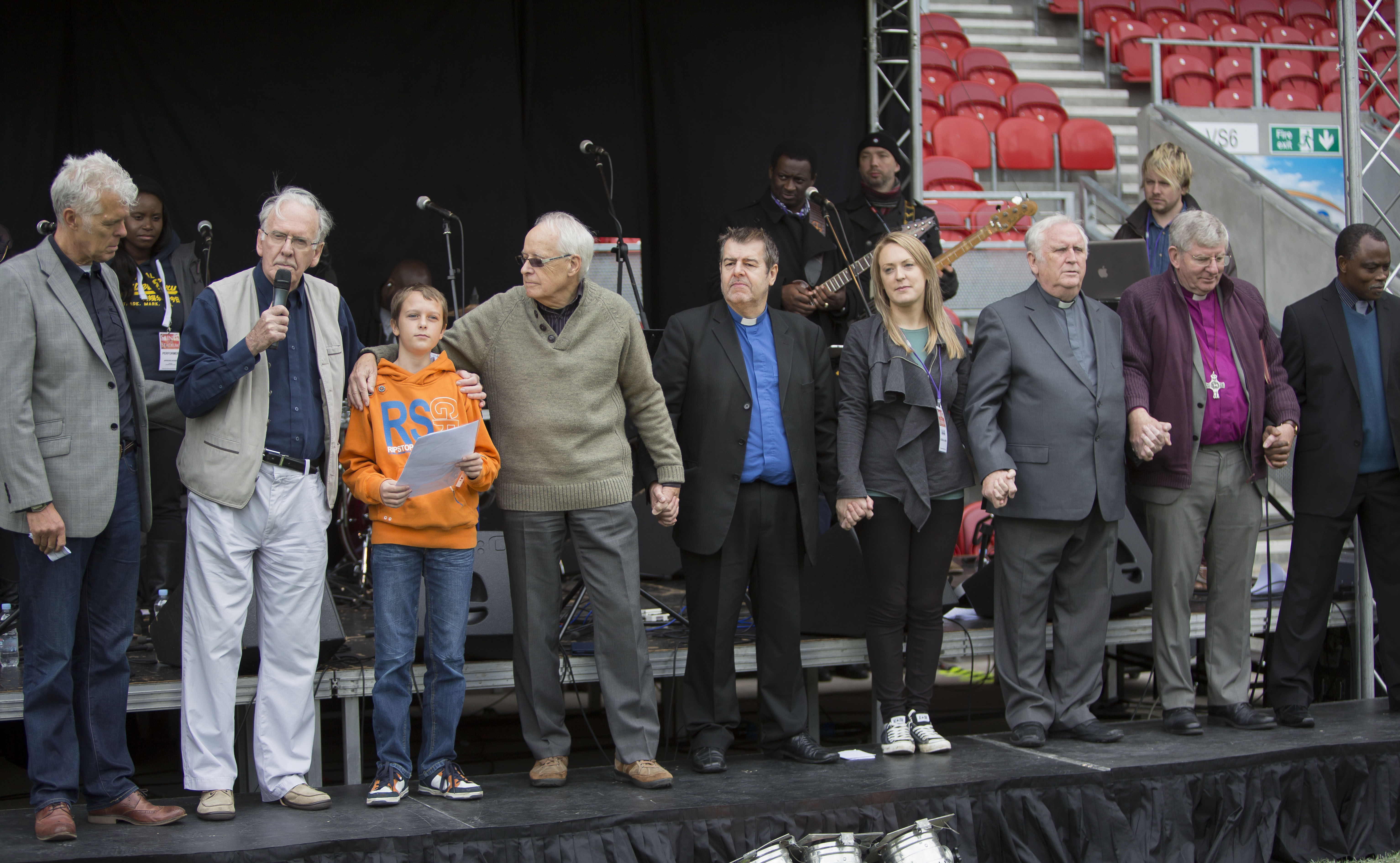
With all that has separated the Body of Christ over hundreds of years there is a mountain of disunity that we need to deal with. At Saints in the Stadium thousands of Christians from all traditions and backgrounds came together to call on God to seek His help for the United Kingdom. Eight people from different denominations of the Church stood and prayed for Oneness in the Body in the United Kingdom.

There is only one God and Father. Centuries of separateness amongst believers for countless reasons does not change the unity of God. Standing together and singing or praying does not change the separation in our hearts. Issues of truth do not become flexible with us simply holding hands.

We can, however, take heart from the increasing number of leaders and church representatives who want to see a change and want to stand together on the basis that Jesus is Lord. We prayed for God’s help in the matter of heart oneness. God is answering this prayer.

Standing together declaring the Lordship of Jesus

The representatives praying at Saints in the Stadium:

Leading – Dennis Wrigley – co-founder of the Maranatha Community

Bishop Geoff Pearson – Church of England Bishop of Lancaster
Father Bill Keogh – Roman Catholic itinerant priest
Rosie Critchlow – Co-ordinator of Network Manchester
Pastor Phil Jump – Chairman of North West Free Church Council
Mr John Cavanagh – Prayer Co-ordinator for Together for the Harvest
Pastor Ayo Akinsanya – Senior Pastor of Deeper Life Church Merseyside
Steve Clifford – Director of the Evangelical Alliance
Calvin Strong – Young People’s Representative
 
Watch here

Catholics and Protestants, Israel, Human Sexuality debate, The End Times…..

December 8, 2013

We can talk forever about unity and togetherness but what about the reality? We can gather, talk and sing about oneness but the real evidence is the way we treat each other. One way to stir up division is to mention controversies – so usually we don’t. We avoid difficult subjects in the pursuit of ‘unity’ but if we want authentic unity with Truth at the centre, we need to face the difficulties between us.

At the Saints in the Stadium national prayer gathering in October 2013 we asked God to help the Church with the problem topics amongst us. We named 8 examples of controversies and with each one we prayed for God to help us:

“Help us to listen in love, and to seek truth together.”

Watch the video here: http://www.youtube.com/watch?v=EMa4HtaQNtA&feature=youtu.be

Business – for a change

November 27, 2013

2013-11-16 14.59.27

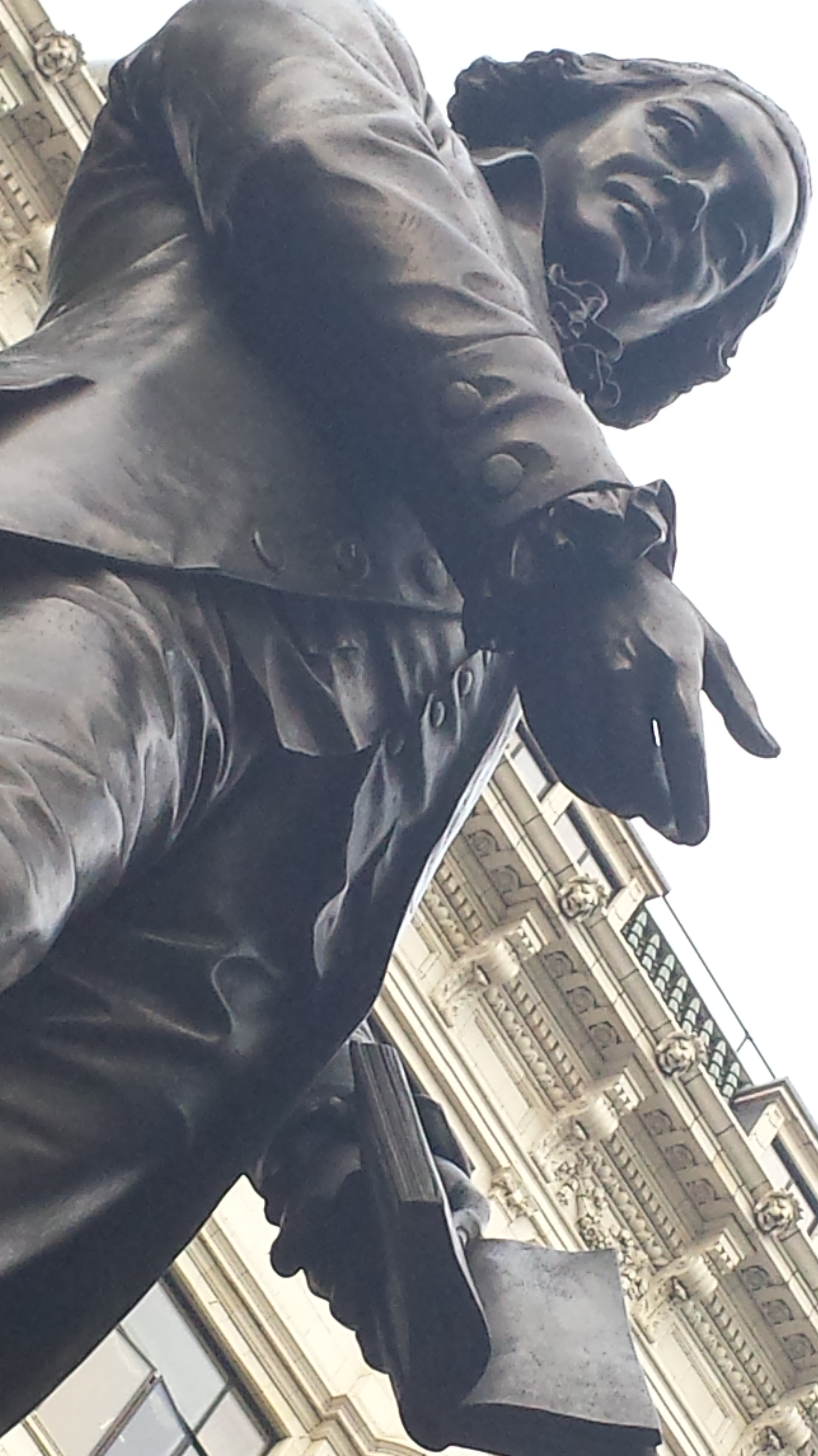
He was described as “cheery, talkative, flamboyant and warm-hearted.”

He was the owner of the Gloucester Journal newspaper in the late 1700’s. Evidently sensitive to the needs in society all around him, his first concern were the poor in Gloucester Prison and particularly those who whose families could not provide for them. Raikes used his paper to make people aware of these needs and to appeal for help. This led to a concern for the children of poor families. He was horrified to see children running wild in the streets without education or real hope. Raikes realised that the prisons were full of people whose lives had been shaped by disadvantaged childhood. Many of the children in the street on a Sunday were working long hours for the other six days and earning pitiful wages. He realised that education was vital and started to fund and promote his idea of Sunday Schools.

As well as publicising the schools he funded much of the cost. His first school began with four women who were paid to teach from the Bible. Robert Raikes himself got involved in the work of the schools by encouraging the children, visiting them in their homes and giving rewards for good progress. Children were welcomed to the classes, whatever their state, and the schools quickly became known as “Raikes’ Ragged School”.

Raikes used his newspaper to make the schools known and the idea spread quickly with interest springing up across the country. Before long, Queen Charlotte, wife of George III, heard of the work and granted him an audience. She was so impressed that she encouraged others to follow his example.

By 1830 over a million children were involved in classes across the country which became the forerunner of the English school system. The evident benefit of these classes led to blossoming social enterprises such as sewing classes, sports clubs and societies for mutual improvement and excursions.

Robert Raikes’ desire to see change in disadvantaged peoples’ lives, began with the prison near his newspaper premises, and the children in the streets where he lived and worked. He engaged with the problem and used his influence and resources in a timely and innovative way. His passionate action fuelled a process that changed England and Great Britain.

Timely and innovative use of influence and wealth changed a nation.

Surely it is time for people of passion and faith to express their conviction and see change now? As a nation we have largely abandoned Christian values and dumbed down those who might speak up for integrity and healthy society. With the nation anxious about knife crime and drug culture, we have a new generation of ‘ragged children.’ The challenge is for people who have the faith, motivation and resources to personally get involved in the challenge.

John Manwell is one of the founders of the North West Christian Business Forum – there are now several hundred members across the North West of England. http://www.nwcbf.org/

The Seventh Coalition is forming…

October 13, 2013

Waterloo!

The battle for the soul of our nation intensifies!

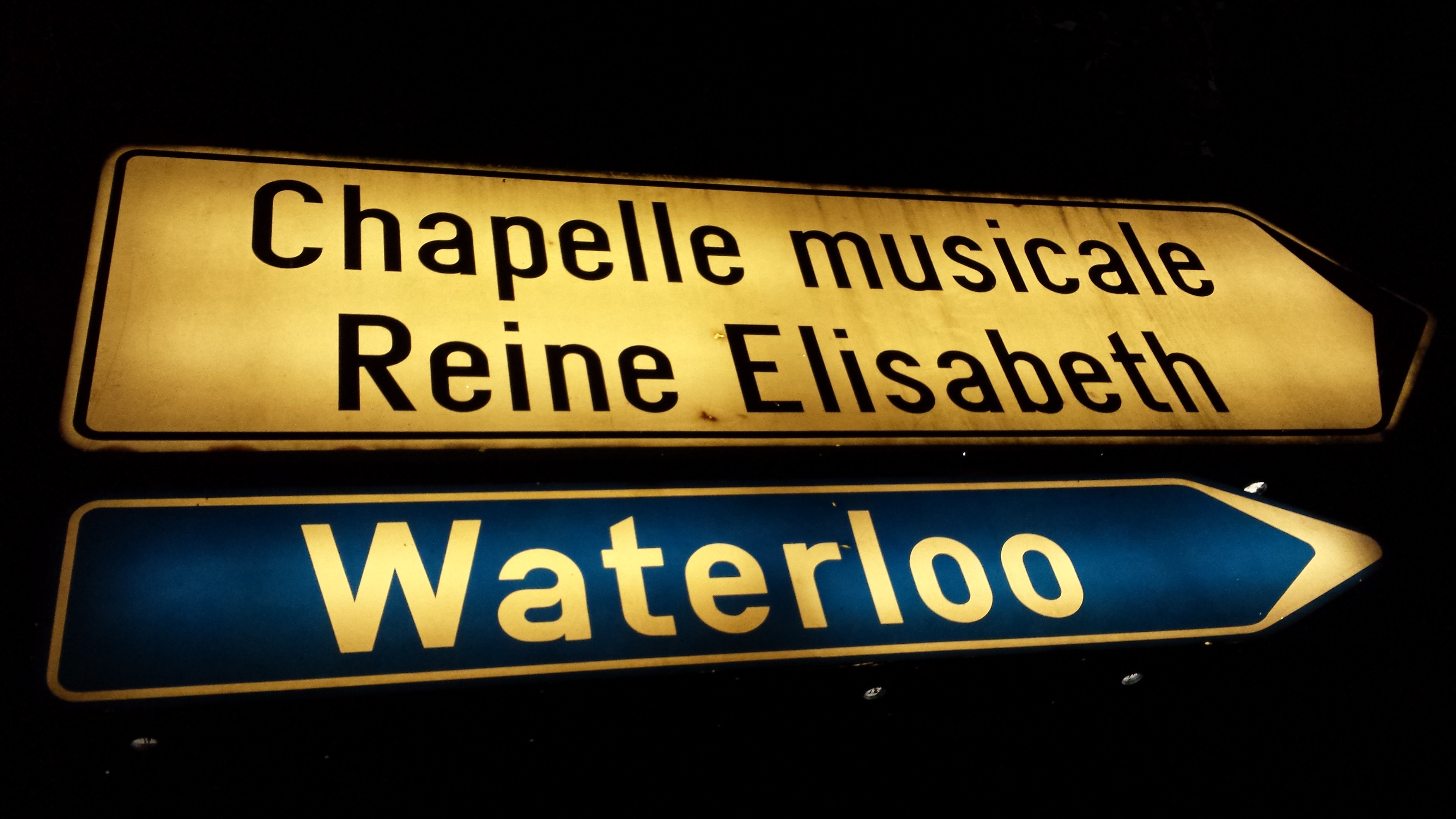
After many months of preparation, yesterday I spent the day in the Saints in the Stadium event in St Helens. Over 2000 people from across the nation came with a united desire to pray for the soul of the nation and for the advance of the Kingdom of God. It seemed like the most unfortunate timing in my schedule to go straight from that event to a business meeting in Belgium. I have been intensely busy with the preparations for Saints in the Stadium, and I had not looked at the address for the location of our meeting. As I arrived at the hotel in Waterloo I started to sense that the Holy Spirit of God was whispering to me.

Over dinner my host explained some of the history from 198 years ago:

The British Duke of Wellington had anticipated over a year before the now famous ‘Battle of Waterloo’ that he would at some point have to confront Napoleon and his goal of dominating Europe. With this in mind he had carefully surveyed the territory and prepared his options. In particular he had chosen the area of Waterloo because of the particular terrain. He chose a location where his troops had a strategic view of the hills and valleys, but where Napoleon’s troops from the other direction would perceive the land to be a level playing field.

Lessons for us:

  •  Plan ahead strategically don’t just react to events.
  • Choose the terrain for the battle – don’t let the enemy choose the battleground

Wellington led an international army called the Seventh Coalition – comprising troops from Prussia, Austria, Russia and Great Britain. In the battle with Napoleon’s troops many soldiers attacked their own people because of the mud which covered everyone, making it hard to identify the enemy.

  • We must be aware of the danger of attacking those on the same side as us because the battle is messy!
  • We need to be in a coalition. It is called the Body of Christ – crossing boundaries of nation, culture and tradition.

We are part of a ‘Seventh Coalition’ in that 7 is God’s number. As I walked around Waterloo this evening I came across a sign on a building “ring 777 for assistance’ !

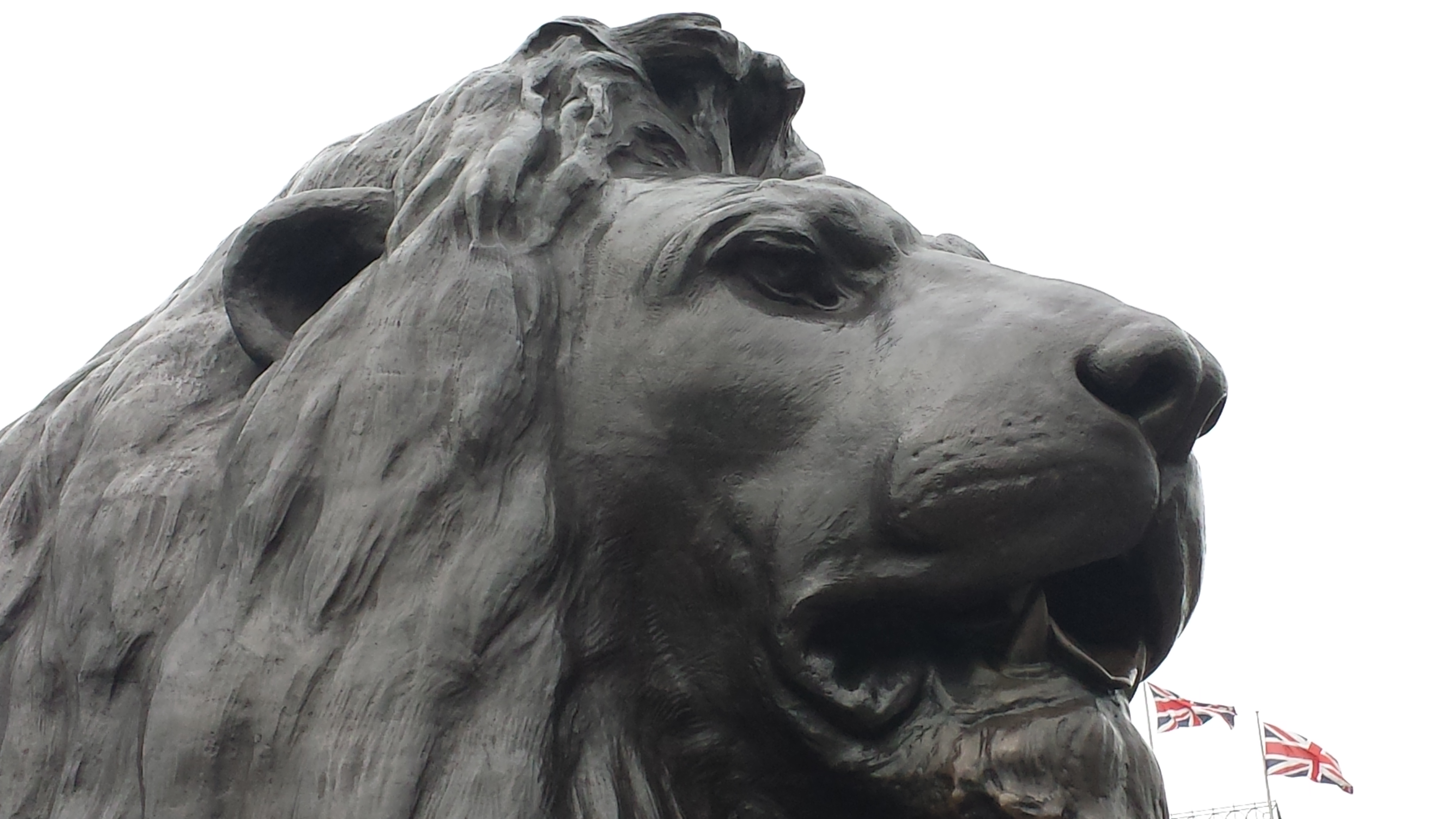
Yesterday in St Helens we made powerful declarations of our desire to work together as One Church in the United Kingdom. The Seventh Coalition is forming, we must think ahead in good time because the confrontation with the forces of domination and control are gathering. Napoleon intended to destroy the British and take control of Europe. The Seventh Coalition under Wellington was prepared and prevailed. Waterloo now has a museum dedicated to these events and the Lion representing the victory of the Seventh Coalition.

The last thing Wellington did before going into battle was to go and pray in St Joseph’s church.

Let us not be overconfident: Wellington’s comment after victory was that the battle “was the nearest-run thing you ever saw in your life.”

 Let the Lion roar again!

Lion of Waterloo